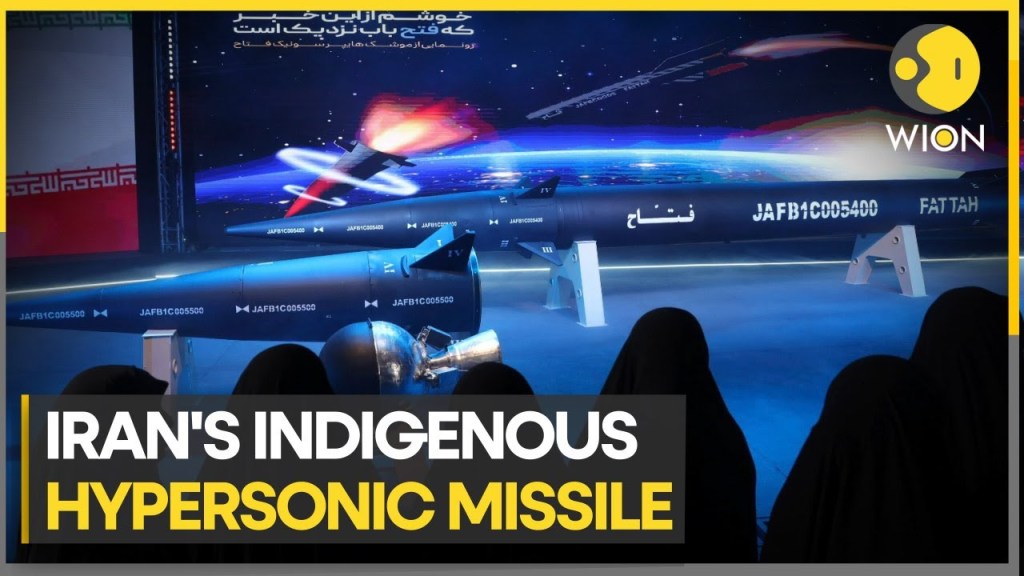
On June 6, 2023, some top Iranian government officials announced the production of a home made medium-range hypersonic missile capable of reaching up to 870 miles.
Russia and China are the two countries that have successfully tested hypersonic missiles whereas the United States is slightly lagging. Lately, Iran shocked the world when it unveiled its medium-range hypersonic missiles to become the fourth country that is in possession of that weapon. But what is a hypersonic missile? And what does it mean to Iran and the entire Middle East?
As described, a hypersonic missile is a weapon capable of traveling at hypersonic speed, defined as between 5 and 25 times the speed of sound or about 1.6 to 8 kilometers per second.
There are two major types of hypersonic missiles. One is the hypersonic glide vehicle (HGV), which leaves the Earth’s atmosphere and then plunges back into it. This type of hypersonic works differently. It exploits physics using dragon friction and flies in all directions like an aircraft but at a superfast speed, making it difficult to detect until it’s too late.
This type of hypersonic flies below the radar horizon, which means the warning time it provides is short. Because it is maneuverable, figuring out where it is heading and what it is targeting is an exceedingly difficult computing task.
The second type is the hypersonic cruise missile (HCM), which, while not as fast, flies low and at extremely high speeds. It uses a superfast crum jet to fly at hypersonic speed and boost-collide vehicle, a warhead that launches aboard a rocket and that is released by falling to Earth at Mach 5 in milliseconds.
In short, hypersonic missiles also have a kinetic energy. They can hit a target at more than 1000 miles an hour, literally packing a punch equivalent to about 3 tons of TNT, resulting in up to 77,600 casualties in an urban area. The Islamic Republic of Iran has this capability; it’s a game changer.
This technological leap of Iran has elevated its military status to a regional power. It is a prowess that means a lot to Iran in many ways. As stated in MIlitary Africa, this technological advancement represents a milestone for the Iranian military. It strengthens the country’s defense capabilities; it significantly alters power in the region; this Fattah missile enhances Iran’s deterrence capabilities; Fattah missiles’ extended range allows Iran to protect its territorial space and to project powers beyond its borders.
What Fattah means to the entire Middle East is something similar to a double-edged sword. So let’s first explore what appears to be the negative aspects of it. Some countries in the Middle East view Iran as a threat. Its rivals feel apprehensive that Iran will someday use its military strength to attack its neighbors. They foresee an already unstable region that the Iranians will exacerbate or eventually take over by force. All this fear will result in an arms race and an alliance of nations that might develop to counter Iran’s military might.
In contrast, Iran’s new-found power has a global positive impact, but people tend to overlook the hidden benefits of it. Iran’s power is not a threat but a stabilizing and equilibrium force capable of countering Israel’s aggressive behavior. Also, Iran, far from being a terrorist state, as it is often labeled, is a country that fights terrorism inside and outside of its borders. Isn’t that globally significant enough for the West to give credit where or to whom it is due?
With Iran probably on the verge of becoming a nuclear power, the Middle East will eventually experience a new era of peace and stability. It will be the time for Israel and Iran to sit down and negotiate peace as equals. From their negotiations, hopeful signs of breakthroughs will emerge. Palestine will be for the Palestinians; Golan Heights will return to the Syrians; Hezbollah and Hamas will be disbanded; and every faction of Muslims and Jews in the region will brotherly embrace one another.
Fattah hypersonic missile is a monumental Iranian achievement. Subsequently, more Iranian technological innovations will emerge. So, with this ingenuity, peace through strength in an unlikely place and among arch-enemies must not be viewed as a matter of wishful thinking but rather as the fait accompli of a distant future.
Basically, I see Iran as an authentic nation-state. And that authentic identity gives it cohesion, which most of the Middle East lacks. Zbigniew Brzezinski
Hubert Odias, Freelance Writer.
 Hubert Odias