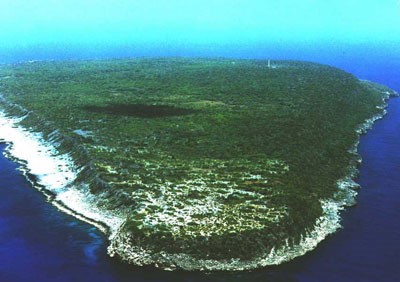
Navassa, an island off the southwest coast of Haiti, has been forcefully taken by the United States since 1857.
The Haitian constitution of 1801 stipulated that Navassa Island is one of the adjacent islands of the mainland. The United States stated that it has seized Navassa because the island was uninhabited and for economic reasons and its guano, which is a rich deposit of bird excrement used to make fertilizer and gunpowder. Geographically speaking, no one can deny that Navassa belongs to Haiti and that the United States has no legal ground to substantiate its usurpation of the island.
On the other hand, Pres. Faustin Soulouque of Haiti used all the necessary means toward a peaceful resolution to the island dispute, including diplomacy and the mediation of the French and the English consuls in Haiti. Unfortunately, nothing worked, the stalemate persisted and the United States remained intransigent.
Ultimately, as Pres. Soulouque ran out of options, he sent an expedition of two naval vessels to retake Navassa by force. The U.S. government warned: “Navassa Island is, henceforth, a U.S. territory.” The United States even went as far as threatening the use of force against any Haitian attempt to retake the island.
So for nearly two centuries, Navassa, a 2 to 3-square-mile Island, has been languishing in the iron claws of the United States. To validate the theft, the United States has issued to Navassa zip code 96898, just like any U.S. town or city.
Besides the seizure of Navassa, America has also kept Haiti politically at bay. For example, the United States’ refusal to recognize Haiti as a country for about sixty years; adversarial trade policies; the imposition of a stiff embargo on Haiti, a new country, fresh out of slavery; the military occupation of 1915 to 1934 and its role in Jean-Bertand Aristide’s removal from the presidency represent tangible proofs of U.S. destructive behavior toward Haiti.
The U.S. military occupation of Haiti was quasi-identical to the French colonial era. It was brutal and one of the darkest periods in Haitian history. Haitians have not forgotten nor forgiven the United States for the looting of the country’s treasury, and all the crimes and abuses committed during 19 years of military occupation.
Also, it is alleged that the United States, France and Canada allied themselves with policies to strangulate Haiti. Those policies are designed to create lawlessness, constant political turmoil and economic stagnation in the country. Their political agenda is to turn Haiti into a failed state. As a cover-up, those countries are the first to offer their assistance to solve the very problem they caused or created.
Their solutions always come in the form of a bandage to cure a cancerous wound. Their assistance always makes the headlines, but little do people know that the resources of the Haitian land that those countries have plundered surpass the assistance given to Haiti by a thousand-fold.
Haiti is still experiencing today a prolonged U.S. occupation. It’s not military, but something conceptual that comes in the form of imperialism and neocolonialism. It’s all about control and manipulation. For example, in Haiti, presidential elections are not free because presidents don’t get elected; they get selected.
It goes like this: the United States picks a candidate and demands that he be president. The Haitian electoral committee responsibly acquiesces. Once ascended to power, the new Haitian president must return the favor. Then, he becomes a puppet and subservient of his “Imperial Master.” His job is to diligently carry out the American demonic plan with sweet deals. It’s full-fledged coercion and corruption to backpedal Haiti down into the precipice.
For example, the seizure of a chunk of a sovereign land from Haiti is a robbery indicative of a bully that applies the rules of the jungle to its benefit. The fable “The Wolf and the Lamb” resonates well with the uncontrollable behavior of the United States. Historically, Jean-Jacques Dessalines, Henry Christophe, Capois-La-Mort and others who fought and died for the land are all grieving in their graves over the loss of Navassa. It is disturbing and sorrowful to see a piece of the land taken away.
In all fairness, Instead of taking Navassa Island by force, why didn’t the United States negotiate a lease or a purchase deal with Haiti? At least, if that was the case, such a transaction would have shown some American dignity and respect. Unfortunately, it’s the opposite. Wow! Does the sovereignty of nations mean anything at all to the United States? What about justice, peace and the democracy that America advocates with so much pride? The United States doesn’t seem to live by what it preaches.
One simple question: what would the United States do if Haiti had stolen an uninhabited island from its territory? In this case, the exception would have been made by applying the predominant rule of strength and by bragging shamelessly: “The reason of the strongest is always the best!” But one thing remains true: Navassa is Haiti; Haiti is Navassa and demands its return.
Source: Navassa Island history.
 Hubert Odias