Hubert Odias, Freelance Writer.
The United States and Iran have been technically at war since the inception of the 1979 Islamic Revolution. Currently, tensions are escalating over Iran’s nuclear program to the point that their belligerent rhetoric and war preparations have reached their climax. So in the absence of direct negotiations, will there be war or a way out of this impasse?
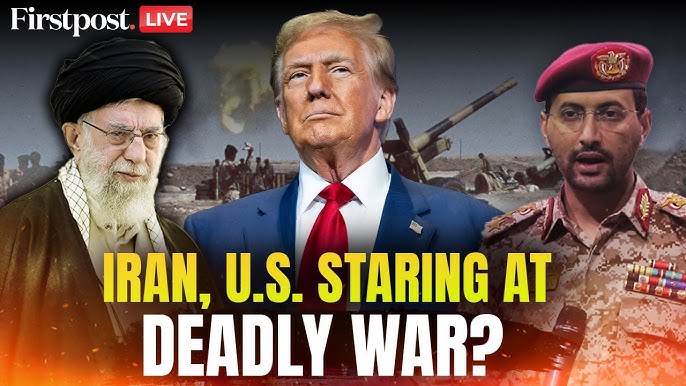
Both countries remain intransigent in their stance on the war. “If they don’t make a deal, there will be bombing, the likes of which they’ve never seen before,” Pres. Donald Trump barked. Likewise, Iran Supreme Leader, Ali Khamenei, remained undeterred and harshly criticized the Trump administration by responding that “if the United States attacks, it will receive a strong and reciprocal blow.” The exchange of mutual hostility indicates the state of things or the prelude of what is to come.
The United States and Iran are stalemating as war preparations reach a point of readiness. New satellite imagery shows that the United States is moving big war machines near Iran. For example, the USS Carl Vinson, USS Princeton, USS Sterett and USS Harry S. Truman, in combination with B-2 stealth bombers stationed at Diego Garcia, exhibit a powerful fighting force.
For its part, the Persian nation has made substantial improvements in the precision and accuracy of its missiles, which make them an increasingly potent conventional threat. Among missiles that Iran would most likely use in wartime are Zulianah with a range of 4000-5000 km; Simorgh with a range of 4000-6000 km, etc.
Iran also possesses a variety of modern armaments, indigenously built or purchased. Its navy includes, among other ships, an Aris Zagros, a frigate of the Moudge class and a multitude of hypersonic ballistic missiles. Unbeknown to many, Russia also supplied Iran with 5th generation stealth airplanes, radar that can detect stealth bombers and guided missiles that can destroy any enemy aircraft. Although not a superpower, Iran is powerful enough to sucker-punch any opponent.
But what if suddenly the war between the United States and Iran breaks out? It would be apocalyptic. With Trump threatening to bomb Iran to oblivion and Iran responding with a similar hostility, the situation remains volatile. The Americans would bomb nuclear installations and strategic military sites. After weakening the Iranian military, the US military would eventually go for regime change, the impossible dream of the West. But Muslims are intrepid and never hesitate to commit martyrdom for Allah or any plausible cause.
Iran would indeed fight back with all its might, although it is not an exact match for the US military. Its navy would lay a siege to the Strait of Hormuz, a vital shipping lane through which 20 million barrels of oil pass daily. Iran would also strike the hell out of Israel with deadly weapons in its vast arsenal. The war could also spread throughout the Middle East, with Shiite allies, Hezbollah, Hamas and the Houthis fighting along.
“I hate war as only a soldier who has lived it can, only as one who has seen its brutality, its futility, its stupidity,” Dwight D. Eisenhower.
The consequences of such a war, if it were to take place, would have left the whole world speechless. Its aftermath would have been worse than the current Russo-Ukrainian war, which causes mounting casualties and infrastructure destruction. The world would experience skyrocketing inflation. The scarcity and high price of gas would trigger a rise in production costs, which would eventually lead to unimaginable inflation.
Additionally, the stock market would likely respond negatively or even crash. All that chaos could have been avoided if only the United States and Israel had shown restraint and respect for the sovereignty and self-determination ideals of the Persian nation, allowing it to freely innovate and transcend the scientific barriers imposed upon it.
Prime Minister Benjamin Netanyahu and Trump swear that Iran cannot possess nuclear weapons. But what if Iran already went nuclear? In 2016, when the Trump administration pulled the United States out of JCPOA (Joint Comprehensive Plan of Action) and imposed severe sanctions, that act provided Iran with a golden opportunity to enrich uranium to weapons-grade.
Without IAEA (International Atomic Energy Agency) representative inspecting the nuclear sites, there is no doubt that Iran has made the best of its endeavor. However, if Iran happens to possess nuclear weapons, unlike popular belief, it’s not proliferation but deterrence and peace. Such a scientific masterpiece should not warrant fear or even war.
Israel had blown up two nuclear reactors in the Middle East: one in Syria, the other in Iraq. In contrast, Iran is different, not an easy country. Western media often stigmatize Iran as a terrorist state. Contrary to popular belief, Iranians died at home and in Syria fighting notorious terrorist groups like ISIS and Al-Nusra that were supposedly created and funded by the West.
Now that Iran is assumed to be a nuclear power, it is war. But if reality prevails in the form of secrecy, isn’t it too late to undo the damage? Again, doesn’t the Middle East need Iran to be a nuclear power to counter Israel’s free reign of aggression and maintain an equilibrium of power in the region?
The war in question would have no justification. Therefore, the United States and Iran would do better to reconsider their decisions. Instead, they should join hands like newfound friends with a common purpose and for the well-being of mankind.
 Hubert Odias